REVIEW · SINGAPORE
Mount Faber, Henderson Waves and Southern Ridges Tour
Book on Viator →Operated by Locals Singapore · Bookable on Viator
Two hours, and Singapore feels bigger. This Southern Ridges hike strings together Henderson Waves and Mount Faber viewpoints with guided nature spotting, so you’re not just taking photos—you’re understanding what you’re walking through. I especially like the guided walk through secondary forest and elevated paths, plus the panoramic city-and-islands lookouts at Faber Point and the Terrace Garden. One thing to consider: the route is outdoors and weather matters, so plan around humid heat and rain.
A small group makes a difference here, and the experience is built for an unrushed pace. Local guide Keith is known for clear communication ahead of time (often via WhatsApp) and for sharing stories about everyday Singaporean life, plus how the city developed its housing and maritime industries. I also like that you’re finishing near Harbourfront MRT instead of getting stuck far from transit.
By the time you reach Mount Faber, you’ll have a real sense of how green spaces connect to urban life. You’ll walk through secondary forest and you may hear and spot creatures like cicadas, and even look for the oriental whip snake basking on branches. Still, don’t expect a silent nature stroll—this is a guided hike with photo stops and time on open viewpoints.
In This Review
- Key highlights you’ll feel (fast)
- Why This Southern Ridges Tour Works in Singapore
- Price, time, and small-group value
- Start at Hort Park Office: your orientation moment
- Stop 1: Alexandra Park and the elevated bridge through secondary forest
- Stop 2: Telok Blangah Hill Park’s Terrace Garden and that 360-degree view
- Stop 3: Henderson Waves and the 36-meter-deep valley
- Stop 4: Faber Point at Mount Faber Park—highest viewpoint payoff
- What the guide adds: local life, plants, and practical storytelling
- Timing, pace, and how to dress for this kind of hike
- Who should book this tour (and who might skip it)
- Should you book Mount Faber, Henderson Waves and the Southern Ridges Tour?
- FAQ
- How long is the Mount Faber, Henderson Waves and Southern Ridges Tour?
- How much does the tour cost?
- Where does the tour start and end?
- What is the maximum group size?
- Is this tour suitable for most people?
- What are the main stops on the route?
- Do the stops require paid admission?
- Does the tour use a mobile ticket?
- Is service animals allowed?
- What happens if weather is bad?
Key highlights you’ll feel (fast)
- Henderson Waves spans a 36-meter-deep valley—a dramatic setting for photos and a quick breath of air.
- Faber Point is the high point in Mount Faber Park with wide panoramic views toward southern islands when the weather cooperates.
- Secondary forest walk with real interpretation—you learn what you’re seeing, not just where to stand.
- Terrace Garden at Telok Blangah Hill Park gives a top-of-the-hill 360-degree Singapore view.
- Small group size (max 7) keeps the hike comfortable and question-friendly.
- Free entry at the stops means you’re paying mainly for the guided route and viewpoints.
Why This Southern Ridges Tour Works in Singapore
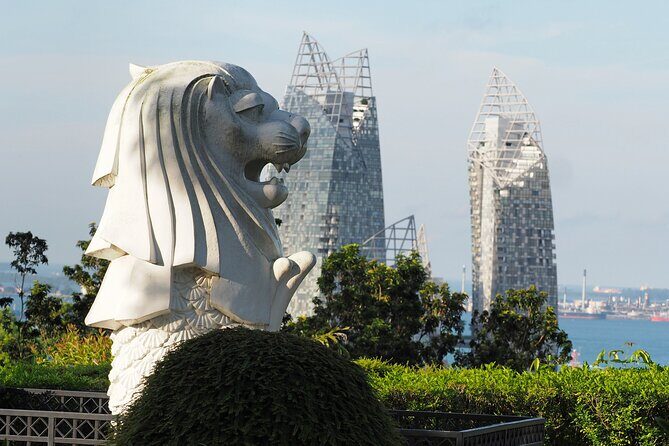
The Southern Ridges are one of those rare city hikes where you get both nature and city context in the same outing. You start in a park area, move through connected hills and valleys, and end with classic skyline views—without needing a full-day plan or extra transport shuffles.
What makes this tour practical is the structure. You get a series of short, focused stops (about 20 minutes each) rather than one long, exhausting slog. That matters in Singapore, where humidity can turn a “quick walk” into a sweaty mission if you’re unprepared.
This also fits different travel styles. If you like nature, the secondary forest section gives you that green Singapore you don’t always notice from the street. If you’re more of a viewpoint person, Henderson Waves and the Mount Faber lookouts deliver. Even if you’re mostly sightseeing, the guide’s focus on local life and development—especially housing and maritime industries—adds depth to what could otherwise be just another bridge-and-view day.
You can also read our reviews of more tours and experiences in Singapore.



Price, time, and small-group value
At $41.97 per person for about 2 hours, the price feels fair for what you’re getting. You’re not paying separate entrance fees at the stops—each segment lists admission ticket free—so the cost is mostly for the guided route, interpretation, and timing.
The best value comes from the “why” behind the walk. A guide helps you notice what you would otherwise miss: forest type details, plant growth stories, and what to listen for (cicadas, bird calls) when the scenery blends together.
Group size also affects comfort and value. With a maximum of 7 travelers, you’re less likely to feel squeezed at viewpoints, and it’s easier to ask questions without the guide rushing. It’s the kind of group size that supports a calm pace rather than a sprint between photo spots.
Also worth noting: it’s booked in advance often (about 130 days on average). That doesn’t mean you can’t find space later, but it’s a hint that people like this route and start planning early.
Start at Hort Park Office: your orientation moment
The tour begins at the Hort Park Office on Hyderabad Road (33 Hyderabad Rd). The practical advantage is that you’re starting in a park setting, so the hike doesn’t begin with a long walk to the “real stuff.”
From here, you head toward Alexandra Park first. Think of the first leg as your warm-up plus your “what am I looking at?” introduction. You’ll also see that the tour is designed to be transit-friendly: it ends at the entrance to Harbourfront MRT station, which makes it easier to grab dinner or continue your day without extra taxis or long detours.
Stop 1: Alexandra Park and the elevated bridge through secondary forest
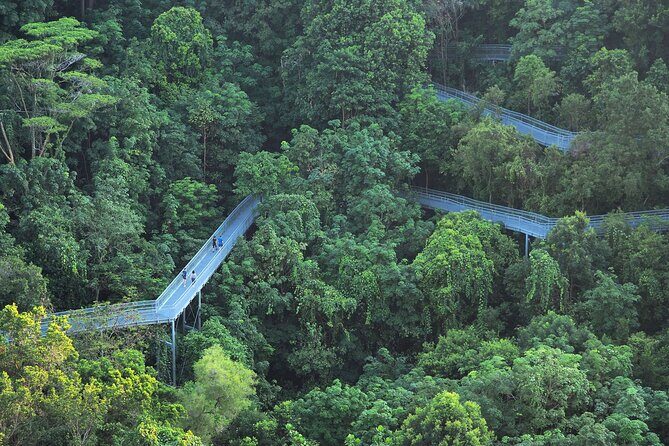
Alexandra Park is your first taste of the Southern Ridges’ quieter side. The highlight is an elevated bridge cutting through adinandra belukar, a secondary forest type that regenerates after earlier heavy agriculture use. That detail is more than trivia. It helps you understand why the vegetation looks the way it does today—Singapore’s nature is young in places, shaped by past land use, then recovering.
This stop is also where the guide’s “nature attention” starts to pay off. The walk passes areas with rich flora and fauna, and the guide points out what to watch for as you go. Even if you’re not a hardcore bird-watcher, this is where you start noticing small cues: how the forest edges change, how light falls through leaves, and what kind of growth you’d miss from a quick glance at street level.
What to watch for here: keep your eyes up and along the branches. On this route you may be on the lookout for wildlife like an oriental whip snake basking on branches, and you may catch signs like bird calls in the background. You won’t control what you see, but having the guide’s pointers makes the chance feel real rather than random.
Possible drawback: elevated paths and bridges mean you’ll likely be in the sun and wind at different moments. If it’s hot or rainy, you’ll feel it more than you would on flat ground under full cover. Good footwear helps, and you’ll want to stay mentally ready for a mix of open air and greenery.
Stop 2: Telok Blangah Hill Park’s Terrace Garden and that 360-degree view
Next comes Telok Blangah Hill Park and its Terrace Garden. This is one of those Singapore spots that looks simple from afar but feels impressive once you’re on it. The terraces are semi-circular and sit near the top, giving you that top-of-the-hill perspective.
The big payoff is the 360-degree view of Singapore. That doesn’t just mean “pretty city.” It helps you get spatial context. You start to understand how the southern part of the city sits relative to the ridges, the water, and the islands. Even if you’ve seen Singapore from a single tower viewpoint before, this kind of shifting horizon from a hill feels different.
The guide’s interpretive role continues here. Rather than letting the stop become a photo scramble, the pacing helps you pause long enough to actually look—then ask questions if something catches your attention.
Possible drawback: the Terrace Garden area is an open viewpoint. In strong sun or after rain, it can be slick or bright. Plan to keep your footing careful and don’t rush your shots.



Stop 3: Henderson Waves and the 36-meter-deep valley
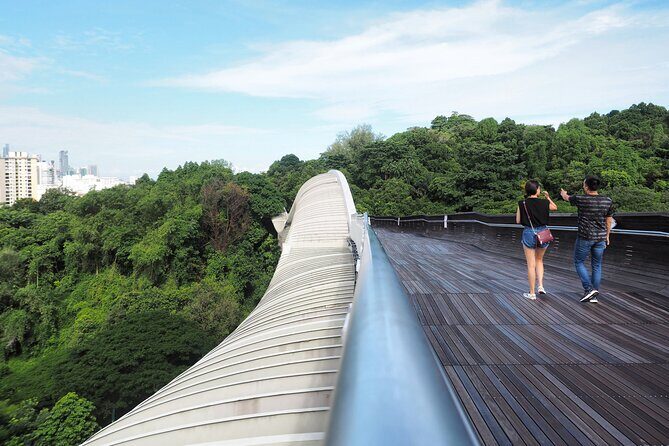
Then you hit Henderson Waves, one of Singapore’s most recognizable pedestrian bridges. The main reason it’s famous is also why it’s worth planning around: the wave-like design arches across a deep valley 36 meters below.
This is your classic photo stop, yes, but it’s more than Instagram geometry. Standing on Henderson Waves gives you a quick, dramatic sense of scale: city planning above, valley space below. And because it’s a pedestrian bridge, you feel the movement of the walkway rather than just staring at a landmark from the side.
The tour timing keeps it simple: about 20 minutes here, enough to get your bearings, take pictures, and enjoy the air. The guide typically helps you spot where to stand for the best angles without turning the stop into a chaotic line.
What you’ll likely notice: the sound changes. Bridges can amplify wind, and that affects how you experience the valley and the surrounding greenery. If the day is clear, you’ll also get better sightlines toward the southern areas that come up again at Mount Faber.
Possible drawback: being a famous photo spot, you can’t always control crowd levels. The small-group format helps, but if you’re extremely photo-obsessed, you may want to arrive early in the day and keep your expectations realistic about wait times for a perfect shot.
Stop 4: Faber Point at Mount Faber Park—highest viewpoint payoff

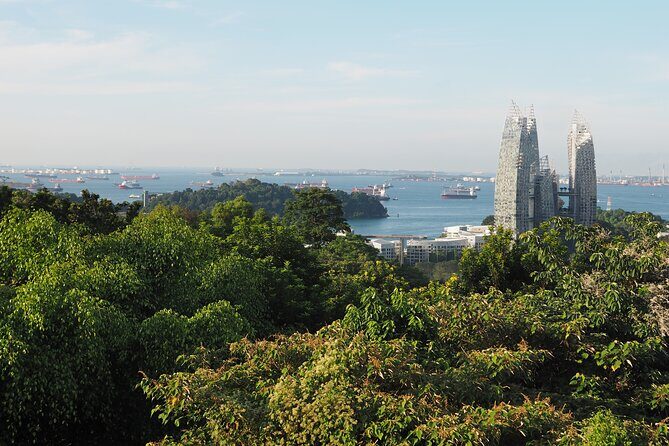
The tour finishes with Mount Faber Park’s highest point: Faber Point. This stop is about the big panoramic payoff. From the lookout areas, you’ll see a wide view of the city, the southern region of Singapore, and—if the weather is good—the southern islands.
If you’ve ever visited Singapore and felt like the city blends into itself, this is where the city starts to separate into regions. Hills, water, skyline, and coastline become more readable. It’s the kind of view that makes you feel like you understand what you’re looking at, even if you’ve only been in the city a few days.
The guide’s role matters again. They don’t just point and say look there. They connect the viewpoints back to how Singapore developed and how everyday life fits into the geography—especially through housing and maritime industry stories.
Possible drawback: viewpoint days depend on visibility. Haze, rain, or low cloud can soften the islands look. The tour requires good weather, and that’s not just a policy detail—it’s what protects the experience quality.
What the guide adds: local life, plants, and practical storytelling
The most praised part of this tour is the guide. On this route, Keith stands out for being passionate and for sharing local knowledge in a way that feels easy to follow. The tone isn’t academic. It’s conversational, with clear answers and a focus on what you can actually observe around you.
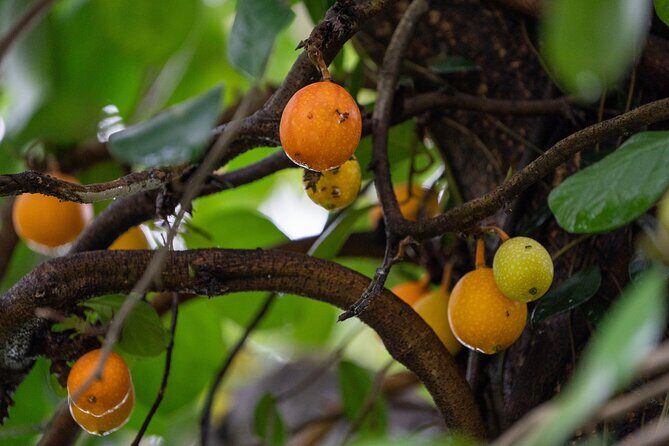
You get a mix of nature and people. On the nature side, you’ll learn about trees and plant growth, and you’ll hear stories that turn everyday plants into something you can identify. One example: a palm tree story connected to a toothpick detail—small, funny, and memorable. That kind of anecdote is how you end up remembering what you saw for weeks.
On the Singapore side, the guide ties the hills into the bigger picture. You’ll learn about everyday life of a typical Singaporean, plus how Singapore’s housing and maritime industries developed. That matters because it changes the walk from scenery consumption into understanding place.
Even communication is part of the experience. The guide provides clear instructions ahead of time, often via WhatsApp. If you need timing flexibility due to jet lag or scheduling, the tour may adjust start time to fit your request—communication makes that possible. That’s a real quality-of-life benefit when you’re traveling across time zones.
Timing, pace, and how to dress for this kind of hike
This outing runs about 2 hours, with multiple short stops. That pacing is designed to keep energy steady rather than spiking and crashing. Still, you’re walking through parks, across bridges, and along elevated paths. You should treat it like an active sightseeing walk, not a casual stroll.
A few practical notes:
- Wear comfortable shoes with good grip. Bridges and terraces can be slick depending on rain.
- Bring a light layer. Singapore can be hot, but shaded forest sections can feel cooler once clouds roll in.
- If weather looks questionable, stay flexible. The experience requires good weather, and you’ll be offered a different date or refund if it gets canceled for poor conditions.
If you’re sensitive to humidity, plan for sweat and take your time at viewpoints. The route is paced for a comfortable scenic walk, but you’ll still be outdoors most of the time.
Who should book this tour (and who might skip it)
This is a great match if you:
- want a nature-forward Singapore day that still includes famous landmarks
- like guides who explain what you’re seeing, especially plants and forest details
- care about panoramic views and not just one big “lookout moment”
- want a small group size so the experience feels calm
You might skip it if you:
- strongly prefer indoor attractions or strictly flat walking
- only want one major viewpoint and don’t want a sequence of stops
- travel on a schedule where a weather-driven change would be hard to manage
Should you book Mount Faber, Henderson Waves and the Southern Ridges Tour?
Yes, if you want a high-value Singapore outing that mixes city views with actual nature context. The pricing makes sense because the stops are admission free and you’re paying for guidance, pacing, and interpretation. The small group of up to 7 also pushes this into the “comfortable and personal” category rather than a crowded photo line.
Book it especially if you like the idea of learning while walking—secondary forest ecology, what to listen for in the trees, and how Singapore’s hills connect to housing and maritime industry stories. If the weather looks good when you travel, this tour turns two hours into a memorable sense of place.
If weather is shaky for your dates, keep an eye on forecasts and be ready to shift plans. When the skies cooperate, the Henderson Waves valley drama and the Faber Point islands-in-the-distance view are exactly the kind of contrast that makes Singapore feel bigger than you expected.
FAQ
How long is the Mount Faber, Henderson Waves and Southern Ridges Tour?
The tour lasts about 2 hours (approx.).
How much does the tour cost?
It costs $41.97 per person.
Where does the tour start and end?
It starts at Hort Park Office, 33 Hyderabad Rd, Singapore 119578, and ends at the entrance to Harbourfront MRT station (7R8C+9G).
What is the maximum group size?
The tour has a maximum of 7 travelers.
Is this tour suitable for most people?
Most travelers can participate.
What are the main stops on the route?
The tour includes Alexandra Park, Telok Blangah Hill Park (Terrace Garden), Henderson Waves, and Faber Point (Mount Faber Park).
Do the stops require paid admission?
The itinerary lists admission ticket free for the stops.
Does the tour use a mobile ticket?
Yes, it includes a mobile ticket.
Is service animals allowed?
Yes, service animals are allowed.
What happens if weather is bad?
The experience requires good weather. If it’s canceled due to poor weather, you’ll be offered a different date or a full refund.